Four Daughters Winery Opens in Minnesota as Familial Affair
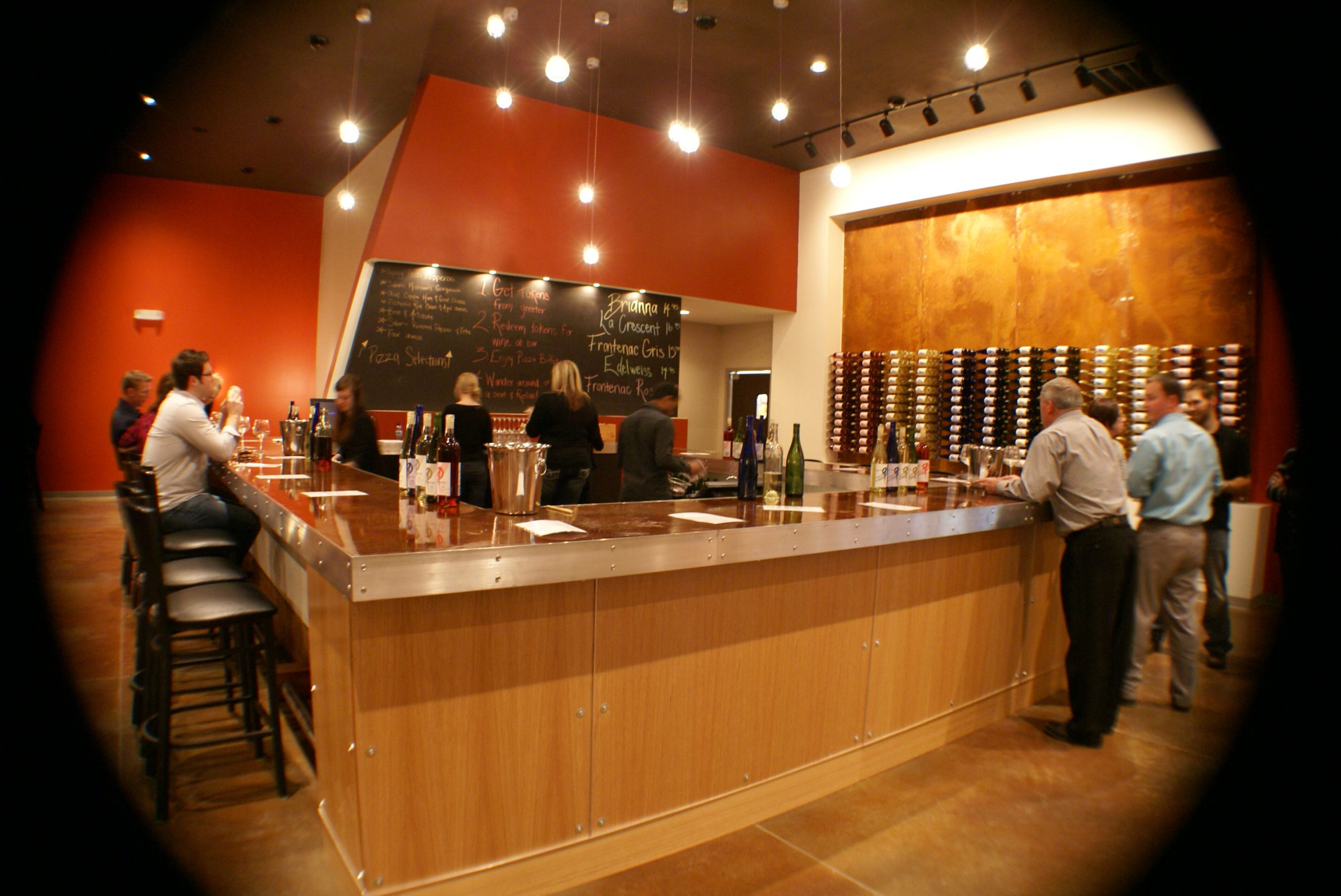
Four Daughters’ interior was designed to be warm and cozy, yet modern and sophisticated.
The trend of Midwestern farmers diversifying from row crops to grapes is growing. For the Vogt family in Southern Minnesota, the motivation for starting the Four Daughters Winery, which opened December 15th, has much to do with continuing the family farm.
Vicky Vogt has farmed the 5,000 acres that Four Daughters now partially occupies with her husband Gary for more than 25 years. As she realized her children were not much interested in a future that relied on growing corn and soybeans, she and Gary decided on a business where all the kids could work together. “Growing grapes and making wine is something they wanted to do,” she said.
The switch to viticulture was a logical move for the Vogt’s whose family’s involvement in the Minnesota wine industry goes back to the 1980s. Vicky Vogt’s late father, Minnesota State Legislator Bob Waltman, helped draft the bill that originally funded the University of Minnesota’s enology program. Today, two of Vogt’s daughters and their husbands are actively involved in the new winery and six acre vineyard.

Justin Osborne, winemaker at Four Daughters Winery, received training through the VESTA wine making program.
Justin Osborne, who is married to Kristin Osborne, one of the “Four Daughters,” is the winemaker. A former construction project manager, Osborne was trained in winemaking by the VESTA enology program though Missouri State University and Central Lakes College in Minnesota.
Justin said that Four Daughters may be the first vineyard in Minnesota to use a Lyre Trellis System. While this system is similar to a Geneva Double Curtain, the canes are trained up instead of down. According to Justin, the main benefit of the Lyre system is that it’s superior for controlling vigor in cold climate grape vines.
As an experiment, Four Daughters planted varietals such as Frontenac, Edelweiss, and Marquette with half the vines on traditional VSP trellising and half on the Lyre trellising. “In three to five years, we’ll be able to convert to the trellis system -VSP or Lyre- that works best for each type of vine,” according to Osborn.
Four Daughters currently has eight labels, all of which are made in the main facility 20 miles south of Rochester. In just two years, the estate Frontenac Gris and Brianna vines have produced enough fruit for a vintage. The Osborne’s attribute this quick maturation to “unbelievable” growing conditions and the fertility of the former cropland soil.
Because an estate grown Marquette is still a few years off, Four Daughters uses Marquette grapes from local vineyards. Justin is currently experimenting with different techniques of Marquette winemaking. One variation of Marquette he is producing in a small batch is a Pinot Noir style using Pinot yeast. (Marquette, a University of Minnesota grape, has Pinot ancestry.) This version undergoes a cold soak, then a quick, hot four-day fermentation, and finally a post fermentation maceration. Justin said that this style of Marquette produces the most natural tannin and therefore ages well.
The second style of Marquette Justin is experimenting with is in the more powerful manner of a Syrah or a Cab and produces a wine with more of a back palate. For this version, a Laffort Zymaflor RB 2 yeast is used to express darker fruit flavors. The more pigmented Marquette spends four days on the skins, then undergoes a five-day hot fermentation at temperatures of 80 to 90 degrees. This version is meant to be consumed immediately.
All Four Daughters’ Marquette, including the one that’s served in Four Daughters’ tasting room, undergoes barrel malolactic fermentation. Osborne said he inoculates his wine immediately after it goes into the barrels. “It can get cool in a wine storeroom in Minnesota during winter and fall, and the secondary fermentation seems to work better while the wine is warm,” he observed.
For the barrels, Justin uses American Oak, including some Minnesota Oak, but he’s careful to limit wood contact with his new barrels lest the oakiness become overpowering. While the barrels impart tannins and structure to Marquette, Osborn thinks it might be necessary to sometimes add tannin to this varietal, particularly if the wine is to be aged.
Justin has not had issues with excess alcohol from Marquette. His grapes came in with 24 brix and the finished wine has a 13.5% alcohol content. As for acidity, after the malolactic fermentation, the Four Daughters’ Marquette pH is around 3.5 with TA’s of less than 10 grams per litre. “The acidity in our Marquette is balanced by the sweet perception of the alcohol,” Osborne said. “It’s more a French style wine; it’s definitely not tart.”
The recent grand opening of Four Daughters was a shoulder-to-shoulder success. That’s partially because the marketing skills of other family Vogt family members, like Kristin Osborne who is a principal at a local public relations firm. To learn more about Four Daughters and Minnesota wine, please visit the winery’s website at www.fourdaughtersvineyard.com.
[wp_geo_map]