Loess Hills AVA Wine Trail Will Require Local Grapes
One advantage of the American Viticultural Area (AVA) designation is that under federal law, any wine with an AVA name on the label must be made from grapes at least 85% local grapes. Any wine with an AVA name on the label in therefore truly “local.”

Doug Grave, president of the Western Iowa Grape Growers Association
Now a proposed wine trail and AVA in Iowa- the Loess Hills AVA Wine Trail- is seeking to apply a local grape requirement as a condition for wine trail membership. Wine trails and AVA’s are both common in the Midwest, but this may the first time the two concepts have been combined.
According to Doug Grave, president of the Western Iowa Grape Growers Association, the exact percentage of local grapes required for a winery to be included in the Loess Hills AVA Wine Trail has not been determined, but a 50% minimum is under consideration.
“Some area wineries are buying out-of-state grapes and juice and, in some instances, imported grapes are replacing local grapes,” Grave said. “We looked at ways to turn this trend around and an AVA in combination with a conditional wine trail was the best method we could find.”
According to Grave, who is a retired U.S. Naval Commander and currently serves as a consultant with the U.S. Strategic Air Command, about half the local wineries don’t use local grapes currently. “Eventually, the goal is have all local wineries using 100% local grapes,” he said.
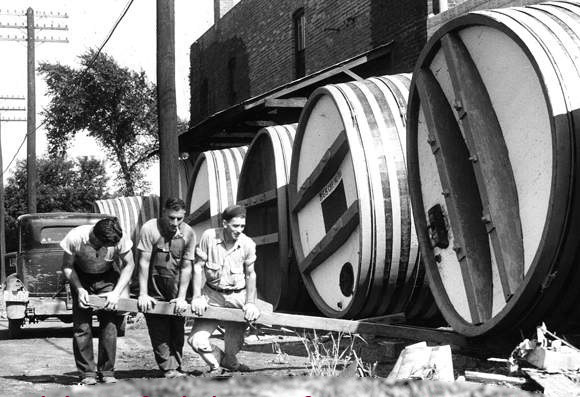
This photo of Council Bluffs winery workers was probably taken during the ’20’s.
Driving across Iowa today, it’s hard to imagine that the state was once a major grape producer. While corn and soy now stretch to the horizon, at the peak of grape production in the late 1920’s, Iowa produced almost 16 million pounds of grapes a year.
One of the centers of Iowa grape production is the Loess Hills, which is an area east of the Missouri River extending from the northwest tip of Missouri to past Sioux City, Iowa. Grapes have been grown here since 1857. Before Prohibition, Council Bluffs, Iowa was the center of local grape production with 21 large growers feeding into the Council Bluffs Grape Growers Association.
Loess soil is one of the main factors that makes Western Iowa good for growing grapes. Loess (pronounced “luss”) is a type of soil that is taken from the German word for “loose and crumbly.” This soil type is common in the United States, but the Iowa Loess Hills are unique in that the Loess layer is 200-300 feet thick places. The only other place on earth with such thick Loess is in China.
And what’s so great about Loess soils for growing wine grapes? First, Loess soils have no hard layers to restrict the growth of grape roots. In addition, erosion has sculpted the Loess Hills into unusual shapes with names like peaks, saddles and cat steps. Vineyards in the Loess Hills are laid out to follow the curve of the hills rather than the traditional north/south rows. The hills also provide drainage and air flow which is conducive to healthy vineyards.
The soil in the Loess Hills vineyards has an acidity that is similar to major European grape growing regions. (Soil pH in the Loess Hills ranges from 6.9 to 7.3 which is less acidic than most soils in the Midwest.)
Certain grapes with Vitis Vinifera and Vitis Berlandieri in their parentage favor this low acid soil, including St. Vincent, Noiret, Vignoles, Traminette, Chardonel, Chambourcin, and Norton.
Back in the heyday of Western Iowa wine grape production, most of the grapes being grown were Concord and other Labrusca varieties. Loess Hills grape production continued strongly after World War II, but then dropped sharply in the 1950’s.
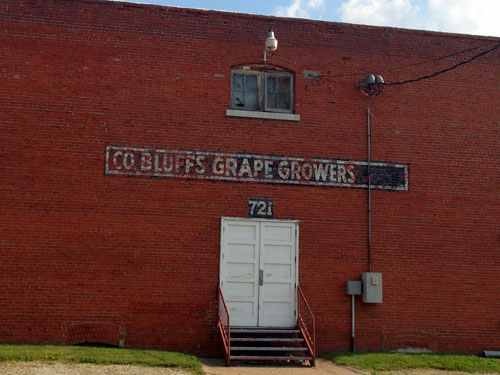
The Council Bluff Grapes Growers building still stands today in Council Bluffs, Iowa.
According to the Loess Hills AVA petition, the use of the herbicide 2,4-D after World War II was one of the main reasons for the decline in grape production, not only in Western Iowa, but across the state. 2,4-D can travel with the wind from soy and corn fields to vineyards where it is lethal to grapes.
Until recently, more environmentally friendly herbicides, like glyphosate, the active ingredient in Roundup weed killer, eliminated the need for 2,4-D. Now, glyphosate has lost its effectiveness, so old herbicides, like 2,4-D, are being reintroduced.
Grave is concerned that 2,4-D may detract from efforts to reestablish Western Iowa as a major grape growing region. “It would be a shame to wipe out all we’ve accomplished,” he said. (Despite lobbying by fruit and vegetable growers, it now appears that new 2,4-D ready GMO crops will be approved soon.)
Despite the risks from herbicide drift, Grave said the Loess Hills AVA is moving forward.
Approval of the AVA is not guaranteed, but after a public comment period ends this summer, the new AVA should be approved by the end of 2014, Grave said.
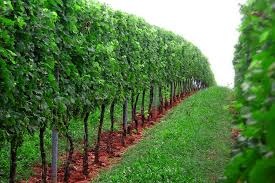
A vineyard in the Loess Hills of Iowa.
According to Grave, Wineries that are considering membership in the Loess Hills AVA Wine Trail are Vine Street Cellars in Glenwood, Prairie Crossing Winery in Treynor, Wabash Wine Company in Shenandoah, Sugar Clay Winery in Thurman, Breezy Hills Winery in Minden, Prairie Hawk Winery in Council Bluffs and King Crossing Winery in Glenwood,
Bodega Victoriana, Grave’s winery which is set to open in the summer of 2015, will be a member of the new wine trail also.
There are now about 70 acres of grapes under cultivation in the Loess Hills. According to Grave, most of the vineyards are two-to-three acres. Grave said new grape growers are planting grapes with a couple of new vineyards coming on-line this spring.
Mark,
The website is not yet up. We received a SCBG grant that will fund the website and the Loess Hills AVA Wine Trail. We will be building both of these out over the summer. We are proud of the fact that the AVA Wine Trail will be the first of its kind in the state (and perhaps the Midwest) whose membership is contingent upon the use of local grapes and is a partnership between growers and wineries to promote local grapes and the wine produced from them. I’ll tell you more about this when we speak next week.
I have attached a copy of the petition and the proposed AVA map. You may use any of the information but please do not forward.
Here is a link to the TTB page that shows our AVA pending:
http://www.ttb.gov/wine/
Thanks,
Doug